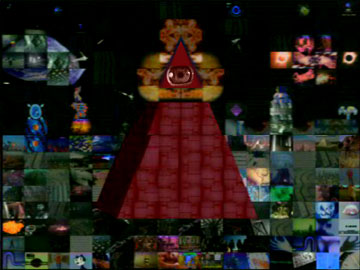
The pyramid was chosen by the founders of the United States to symbolize the power and abundance of natural resources they expected of the new nation. Surveying it all was the watchful eye of God. Over two hundred years later we are most likely to associate this image with money, familiar to us all from its prominent location on the back of the one dollar bill. The resources represented by the great building blocks of the pyramid have now dwindled or become obsolete. Increasingly, what sustains this society is information, and that often comes in the form of electronic images. Through our Great Eye we image a world, and the rest of the world wants to know what it looks like. Increasingly, the electronic image has become the currency with which we conduct business, entertain ourselves, and even consider spiritual issues. Ubiquitous media images reflect our culture, even as they shape and influence it. The production and consumption of this information is no longer localized, but is disseminated at lightning speed worldwide. From bits and pieces a cultural identity is available for the world to see. In this multi-media installation, I have drawn from this wealth of imagery, and placed it at the hands of the viewer/participant. To live in the world today is to experience an overload of media, and this piece is made up of over two hundred and fifty samples of video image and sound, which at times are seen simultaneously. Just as the experience of channel-hopping or cruising the Internet can diminish the primacy of any one image, the samples in this piece can function simply as bits of color and value, like fabric scraps which make up a crazy-quilt image. They are always seen in groupings, challenging the viewer to make connections, and decode new meanings, reflecting skills we must have to remain media-literate. In its exhibition at the Corcoran Gallery of Art in Washington, D.C., many people, especially young people were drawn in to interact with the piece, to ³see how it worked". Facing the ³New Order² of images represented here illuminates a world in which images can now play a large role in toppling governments, fight wars, and threaten indigenous cultures as well as educate and entertain.
Martha McWilliams, "Luxor v1.0..." Washington
City Paper, Oct. 21, 1994. 42.
John Dorsey, "Corcoran Exhibit Looks at Influence of Media Images", Baltimore
Sun, Nov. 6 1994. 1H.
Philip Brookman, "Luxor v1.0..." (Exh. Cat., Corcoran Gallery of Art, Washington,
DC).