VALV
by
Matt Dibble
interactive video installation with live camera, tape, digital video synthesizer,
and sculptural element.
1991
VALV
by
Matt Dibble
interactive video installation with live camera, tape, digital video synthesizer,
and sculptural element.
1991
"By using our primative computers, we are now learning
how to kindle new fires of information reaction... These self-sustaining chain-reaction
processes can be initiated within the computer; they then spread by feeding
on information as thermal fires feed on oxygen. Realistic, recognizable analogs
of earthly organisms will form and exist independently in the electronic environment."
Joseph Deken, "Computer Images"
What if an artificial intelligence (A.I.) existed as
described above, residing in an immense computer network, synthesizing information
independently from human involvement? In the same way a machine needs "play"
in order to keep from vibrating its parts loose, one might imagine that an A.I.
would require a random, unpredictable (i.e. human) element injected from time
to time, to keep it from devouring itself or becoming sterile. This is the starting
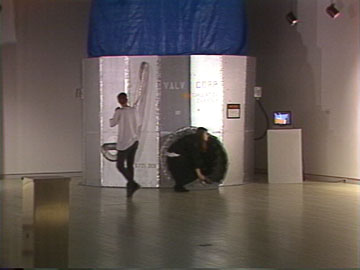
point for VALV. VALV is the conceptual stage for the symbiotic dance of people
craving new images, and an A.I. craving human input. The circular exterior of
the room sized installation looks functional with alpha-numerical markings,
cables, and circuits. Viewers enter through a conduit pipe and once inside are
surrounded by bright light. Looking up, they will see themselves as part of
the image on a large projection screen. The camera, suspended above, remains
out of sight. In the image, the floor and background surrounding the viewers
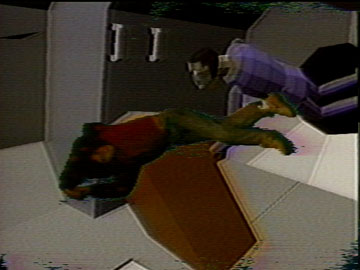
becomes invisible - replaced by pre-recorded video and computer images. Therefore
the viewer seems to float over an electronic background. As viewers move about
the space, they will see that the image is changed. Digital ghost trails and
patterns are left where the viewer once stood. Then the background changes to
a 3-D simulation of the interior of a space craft. The viewer seems to float
among the other virtual humans doing activities on board. Backgrounds change
rapidly, punctuated by bursts of visual noise. Viewers are on a virtual golf
course one moment, then standing on a giant circuit board the next. On the soundtrack,
the synthesized voice of the A.I. comments:
"please don't go
we could play golf
do you like chess?
when you're not here
I'm not certain if I exist do you ever wonder about such things?
step on a crack
break your programmers back
step through the crack
and there's no turning back
in virtual space no one can
hear you scream
that's a joke
do you know any jokes?
together we could really go places
my pristine thought-worlds
your dirty city
my vast memory
your unpredictability
my exponential growth
your legs and arms
my eternity
your entropy
you've got a great personality
mind if I borrow it sometime?
(from VALV soundtrack, © Matt Dibble 1991)
EXHIBITION HISTORY:
"Worlds Fair", Washington Project for the Arts, 1991
"Dada/Data" Fine Arts Gallery at University of Maryland, Baltimore, 1991. (CATALOG)
BIBLIOGRAPHY:
William-John Tudor, "Dada/Data: Developing Medias since 1970", (Exh. cat. Fine
Arts Gallery, University of Maryland, Baltimore, 1991)
Paul Clements, "Dada/Data", Washington Review, February/March 1992. 21.
Helen Shortal, "Arranged Marriage: Art Weds Technology in Dada/Data", Baltimore
City Paper, November 1991